
Contact us
We will resolve your inquiry within 24 hours.
Key Differences: Hospital Pharmacy vs Retail Pharmacy
Introduction
Pharmacies are essential pillars of healthcare, ensuring that patients receive safe and accurate medications. While retail pharmacies are familiar to most people, hospital pharmacies remain less understood—despite being crucial for hospital supply, medication safety, and clinical coordination.
This blog clearly explains how hospital pharmacies differ from retail pharmacies, their responsibilities, workflows, and why hospitals depend on reliable partners like the SHOBHIT MEDIWORLD Hospital Pharmacy Chain for uninterrupted Hospital medicine supply.
What is a Hospital Pharmacy?
A hospital pharmacy is a core department within a healthcare facility, responsible for the complete management of Hospital medicine supply, inpatient medication support, and adherence to high safety standards.
Hospital pharmacists work closely with doctors, nurses, and clinical teams to ensure every medication is accurate, evidence-backed, and suitable for the patient’s condition.
Key Features of a Hospital Pharmacy
- Centralized hospital supply system
- Handling of controlled and high-alert medicines
- Inpatient dispensing
- Ward-level Inventory distribution
- Clinical drug monitoring
- Emergency & critical care drug accessibility
Modern hospitals use digital tools for expiry tracking, batching, inventory recording, and invoice accuracy.
What is a Retail Pharmacy?
A retail pharmacy (community pharmacy) serves the general public, offering prescription and over-the-counter medicines along with general health products.
Key Features of Retail Pharmacy
- Dispensing to walk-in customers
- Selling OTC products
- Basic health guidance
- Insurance billing (in some regions)
- Demand-based inventory management
Retail pharmacies focus more on customer service than clinical operations.
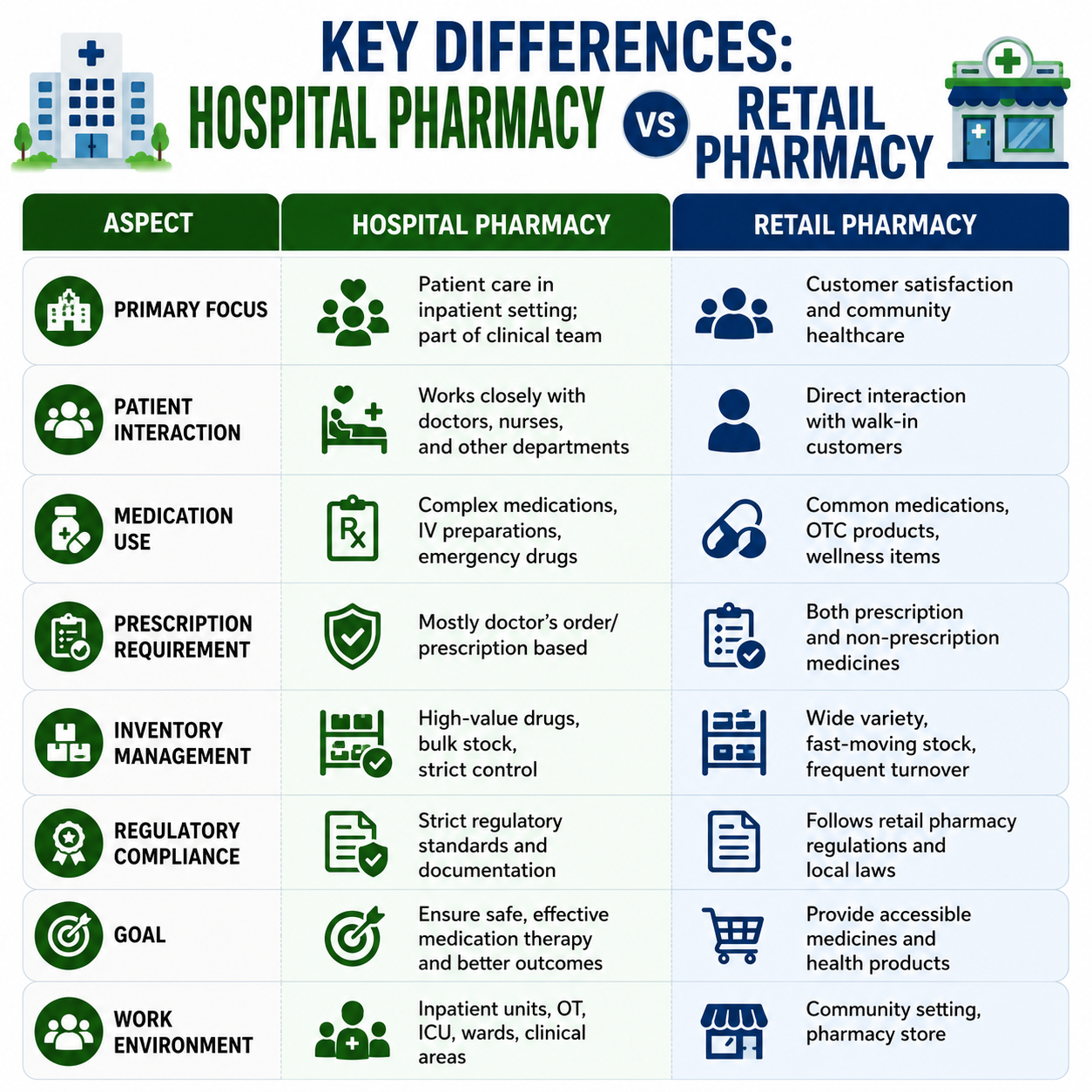
Hospital Pharmacy vs Retail Pharmacy: Key Differences
1. Purpose & Role
Hospital Pharmacy
Supports patient treatment inside the hospital by dispensing and monitoring medicines for admitted and emergency cases.
Retail Pharmacy
Provides medicines and health products to customers for home use.
2. Inventory & Stock Levels
Hospital Pharmacy
Manages a large and critical Inventory, including:
- Emergency medicines
- IV fluids
- Specialty and high-risk medicines
- Surgical supplies
They require:
- Real-time stock tracking
- FEFO/Expiry-based distribution
- Batch & lot monitoring
- Predictive Hospital medicine supply planning
Hospitals prefer dealing with structured chains like the SHOBHIT MEDIWORLD Hospital Pharmacy Chain, the Largest hospital pharmacy chain in India – Shobhit Mediworld, known for accuracy, reliability, and professional supply operations.
Retail Pharmacy
Maintains smaller, fast-moving stock for general consumer demand.
3. Workflow Differences
Hospital Pharmacy Workflow
- Prescription verification
- Dose calculation
- Ward/ICU delivery
- Handling emergency drugs
- Coordinating with multiple departments
Retail Pharmacy Workflow
- Accepting prescriptions
- Billing & dispensing
- Customer guidance
- Selling OTC items
Retail workflow is simpler and consumer-oriented.
4. Medication Safety Protocols
Hospital Pharmacy
Follows stringent safety measures such as:
- High-risk drug handling
- Sterile preparations
- Adverse drug reaction reporting
- Dosage calculation based on patient condition
Retail Pharmacy
Ensures prescription accuracy and OTC counseling, but does not perform sterile compounding or complex clinical duties.
5. Technology Use
Hospital Pharmacy
Works with systems that support:
- Digital prescriptions
- Barcode-based dispensing
- Automated stock visibility
- Detailed reporting for audits
Retail Pharmacy
Uses basic billing software and POS systems without clinical integration.
6. Pharmacist Expertise
Hospital Pharmacists
Trained in:
- Clinical pharmacology
- Drug interactions
- Critical care medicines
- Chemotherapy drug handling
- Sterile compounding
Retail Pharmacists
Trained for:
- OTC medicines
- Customer service
- Prescription accuracy
- Retail inventory handling
7. Supply Chain & Procurement
Hospital Pharmacy
Procurement involves:
- Bulk purchasing
- Vendor evaluation
- Quality checks
- Centralised hospital supply chain processes
Retail Pharmacy
Procures from local distributors and wholesalers based on demand.
Why Efficient Hospital Pharmacy Operations Matter
A hospital pharmacy that is not well-managed may face:
- Stockouts
- Incorrect dispensing
- Expired drug wastage
- Poor patient outcomes
Many hospitals rely on advanced tools and strong supply partners for smooth functioning.
The SHOBHIT MEDIWORLD Hospital Pharmacy Chain, the Largest hospital pharmacy chain in India – Shobhit Mediworld, ensures:
- Timely Hospital medicine supply
- Affordable procurement
- Seamless inventory support
- End-to-end service coverage
- Strong network as a trusted medicine supplier in India
This makes Shobhit Mediworld one of the most dependable partners for hospitals across the country.
Conclusion
Hospital and retail pharmacies both play important roles—but they differ greatly in purpose, workflow, safety protocols, and inventory complexity.
Hospital pharmacies must maintain strict clinical standards, efficient hospital supply, and accurate Inventory processes.
To achieve this, hospitals increasingly rely on technology, structured systems, and trusted medical supply chains like the SHOBHIT MEDIWORLD Hospital Pharmacy Chain—the Largest hospital pharmacy chain in India.
Reliable medicine suppliers in India and systematic processes ensure patient safety, uninterrupted drug availability, and efficient healthcare operations.