
Contact us
We will resolve your inquiry within 24 hours.
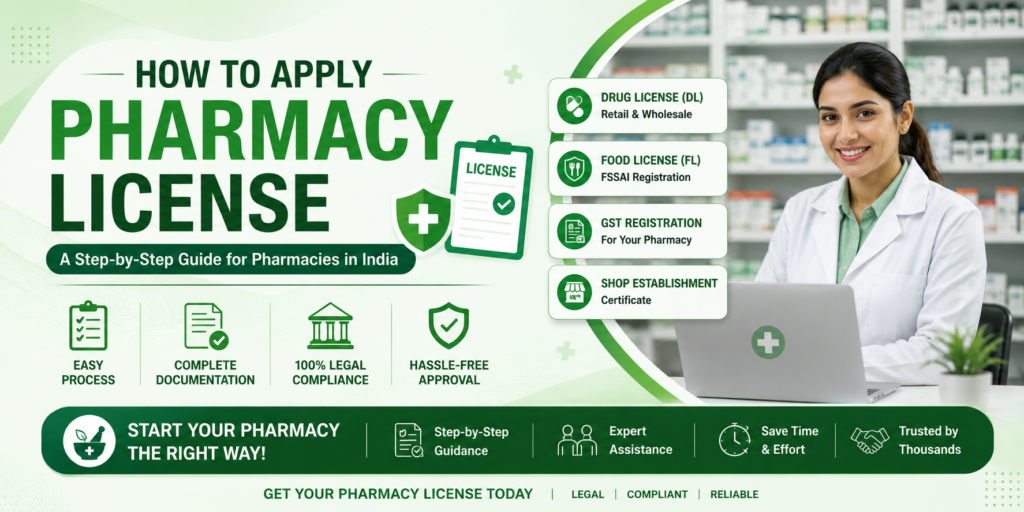
Starting a pharmacy business in India requires proper legal approvals and documentation. Whether you are opening a retail medical store, wholesale pharmacy, or hospital pharmacy, understanding the complete licensing process is essential for smooth operations and legal compliance.
This guide explains everything about Pharmacy licensing India, including the Drug license DL process, Food license FL for pharmacy, GST registration, and other regulatory requirements.
Why Pharmacy Licensing is Important
A pharmacy handles medicines and healthcare products that directly affect patient safety. Because of this, government authorities strictly regulate pharmacy operations.
Having proper licenses helps you:
- Operate legally
- Avoid penalties and legal action
- Build trust with patients and hospitals
- Ensure safe medicine handling
- Maintain proper inventory and compliance
Proper Pharmacy regulatory compliance is essential for every pharmacy business in India.
Types of Licenses Required for a Pharmacy
1. Drug License (DL)
The most important requirement for any pharmacy is a drug license.
The Drug license DL process is regulated under the Drugs and Cosmetics Act, 1940. This license allows businesses to store, distribute, and sell medicines legally.
Types of Drug Licenses
Retail Drug License (RDL)
Required for:
- Retail medical stores
- Chemist shops
- Hospital pharmacies
Wholesale Drug License (WDL)
Required for:
- Medicine distributors
- Stockists
- Pharma wholesalers
Documents Required for Drug License
For the Drug license DL process, the following documents are usually required:
- Pharmacist registration certificate
- Aadhaar card & PAN card
- Shop agreement or ownership proof
- Blueprint/layout of pharmacy
- Refrigerator bill for temperature-sensitive medicines
- Qualification certificates
- Affidavit and declaration forms
- Electricity bill
- Passport-size photographs
For hospital pharmacies, additional Hospital pharmacy documentation may also be required.
Steps in Drug License DL Process
Step 1: Prepare Documentation
Collect all necessary documents carefully before applying.
Step 2: Apply Through State Drug Authority
Applications are submitted through the state drug control department portal.
Step 3: Inspection
Drug inspectors may visit the premises to verify:
- Storage conditions
- Refrigeration facilities
- Pharmacy space
- Pharmacist availability
Step 4: Approval & License Issuance
Once approved, the license is issued officially.
The entire Drug license DL process may take a few weeks depending on the state authority.
Food License FL for Pharmacy
Many pharmacies also sell:
- Protein supplements
- Nutritional products
- Energy drinks
- Health foods
In such cases, a Food license FL for pharmacy becomes mandatory under FSSAI regulations.
Without this license, pharmacies cannot legally sell food-based healthcare products.
Documents Required for Food License
To apply for a Food license FL for pharmacy, commonly required documents include:
- PAN card
- Address proof
- Drug license copy
- Shop ownership proof
- Passport-size photo
- Business constitution certificate
The license type depends on your business turnover and operations.
GST for Pharmacies
GST registration is another important requirement.
GST for pharmacies is mandatory when turnover exceeds the prescribed limit or when interstate supply is involved.
Benefits of GST registration include:
- Input tax credit
- Legal invoicing
- Easier business expansion
- Better compliance management
Documents Required for GST Registration
For GST for pharmacies, you typically need:
- PAN card
- Aadhaar card
- Business address proof
- Bank account details
- Drug license
- Business registration proof
GST registration can be completed online through the GST portal.
Shop Establishment Certificate for Pharmacy
Most states also require a Shop establishment certificate for pharmacy operations.
This certificate regulates:
- Working hours
- Employee rights
- Commercial establishment registration
The certificate is issued by the local municipal or labor authority.
CDSCO Guidelines for Pharmacies
The Central Drugs Standard Control Organization regulates medicine-related compliance in India.
Following CDSCO guidelines is essential for:
- Medicine storage
- Record maintenance
- Drug procurement
- Controlled substance handling
- Labeling compliance
Ignoring CDSCO guidelines may result in penalties or suspension of licenses.
Hospital Pharmacy Documentation Requirements
Hospital pharmacies often require additional approvals and documents due to larger operations.
Important Hospital pharmacy documentation may include:
- Hospital registration certificates
- Biomedical waste agreements
- Fire safety clearance
- Pharmacist appointment letters
- Purchase and stock registers
- NABH compliance documents
Proper documentation helps hospitals maintain smooth audits and inspections.
Pharmacy Compliance Checklist
A proper Pharmacy compliance checklist helps avoid legal problems and operational issues.
Important Compliance Points
License Display
All licenses should be visibly displayed.
Temperature Monitoring
Maintain proper cold-chain storage for sensitive medicines.
Expiry Monitoring
Track expiry medicines regularly.
Purchase Records
Maintain supplier invoices and stock records.
Pharmacist Availability
Registered pharmacists should be available during operational hours.
GST Compliance
File GST returns on time.
Renewal Tracking
Renew all licenses before expiry dates.
A strong Pharmacy compliance checklist improves operational efficiency and inspection readiness.
Importance of Inventory & Procurement Management
Modern pharmacies should also focus on:
- Inventory optimization
- Purchase management
- Expiry control
- Demand forecasting
Using software for inventory and procurement improves:
- Stock accuracy
- Compliance
- Profitability
- Audit management
This is especially important for hospitals and multi-store pharmacy chains.
Common Mistakes While Applying for Pharmacy License
Avoid these mistakes during Pharmacy licensing India process:
- Incorrect documentation
- Incomplete pharmacist details
- Improper storage setup
- Missing GST registration
- Delayed renewals
- Ignoring CDSCO guidelines
These issues can delay approvals significantly.
Conclusion
Obtaining the correct licenses is the foundation of a successful pharmacy business. From the Drug license DL process to Food license FL for pharmacy, GST registration, and regulatory approvals, every step plays a crucial role in legal and operational success.
Following proper Pharmacy regulatory compliance, maintaining updated Hospital pharmacy documentation, and using a structured Pharmacy compliance checklist can help pharmacies operate smoothly while improving trust, safety, and profitability.
If you are planning to open a pharmacy or manage a hospital pharmacy, ensure every license and compliance requirement is completed properly before operations begin.