
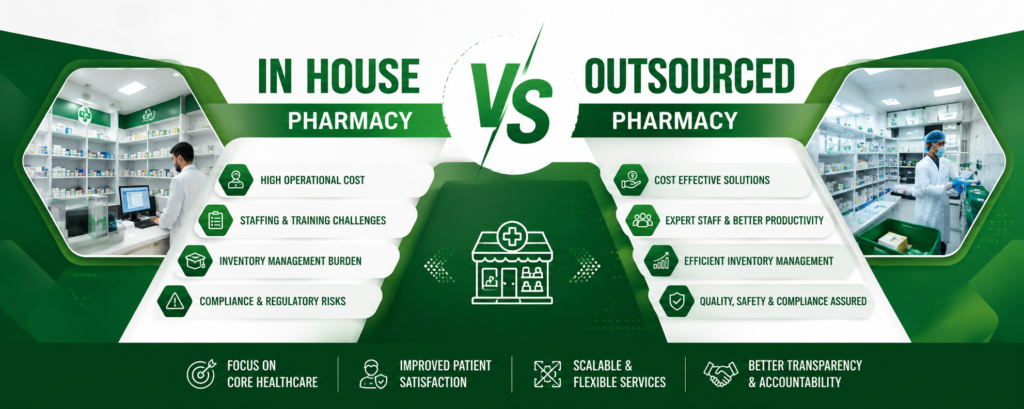
Efficient pharmacy operations are essential for every healthcare institution. Hospitals rely heavily on pharmacy departments to ensure medicine availability, patient safety, inventory control, and smooth healthcare delivery. However, many healthcare organizations today face an important operational decision — choosing between an in-house pharmacy model or an outsourced pharmacy model.
The debate around In-House vs Outsourced Hospital Pharmacy has become increasingly important as hospitals aim to improve operational efficiency, reduce costs, and enhance patient care. Both models offer unique advantages and challenges, and the right choice depends on the hospital’s operational goals, financial planning, and healthcare requirements.
In this blog, we will explore the differences between both models, their benefits, challenges, and how hospitals can choose the best pharmacy management approach.
What is an In-House Hospital Pharmacy?
An in-house pharmacy management model means the hospital independently manages all pharmacy operations. The hospital is responsible for staffing, inventory procurement, medicine storage, billing, compliance, and daily pharmacy workflows.
In this model, the hospital has complete control over:
- Pharmacy operations
- Medicine procurement
- Inventory management
- Staff recruitment
- Billing and reporting
- Regulatory compliance
Many hospitals prefer in-house pharmacy systems because they provide direct operational control and customized workflow management.
What is an Outsourced Hospital Pharmacy?
In an outsourced pharmacy model, hospitals partner with external pharmacy management companies that handle pharmacy operations on behalf of the healthcare institution.
Under outsourced hospital pharmacy services, third-party providers manage:
- Medicine inventory
- Procurement operations
- Pharmacy staffing
- Billing systems
- Stock monitoring
- Compliance management
- Operational reporting
This model allows hospitals to focus more on patient care while pharmacy experts handle operational responsibilities.
Key Differences Between In-House and Outsourced Hospital Pharmacy
Factors | In-House Pharmacy | Outsourced Pharmacy |
Operational Control | Full hospital control | Managed by external experts |
Staffing Responsibility | Hospital-managed | Outsourcing company-managed |
Inventory Management | Internal management | Professional inventory systems |
Operational Costs | Higher fixed costs | Optimized operational costs |
Technology Adoption | Depends on hospital investment | Usually advanced systems included |
Scalability | Limited flexibility | Easier scalability |
Compliance Management | Internal responsibility | Managed by service provider |
Understanding these differences is important when evaluating In-House vs Outsourced Hospital Pharmacy strategies.
Benefits of In-House Pharmacy Management
Many healthcare organizations continue using in-house pharmacy systems due to the following advantages:
1. Full Operational Control
Hospitals maintain complete authority over pharmacy decisions, staffing policies, procurement processes, and inventory workflows.
2. Customized Workflow Management
An internal pharmacy allows hospitals to design workflows according to their operational structure and patient requirements.
3. Direct Communication
Hospital departments can communicate directly with pharmacy teams, improving coordination and emergency response.
4. Brand Consistency
Hospitals can maintain their internal service standards and operational culture more effectively.

Challenges of In-House Pharmacy Management
While in-house models provide control, they also come with operational challenges.
High Operational Costs
Managing pharmacy operations internally requires investment in:
- Staff salaries
- Technology infrastructure
- Inventory systems
- Compliance management
- Procurement processes
Inventory Management Complexity
Managing large medicine inventories manually or inefficiently can lead to:
- Stock shortages
- Overstocking
- Medicine expiry losses
Staffing Challenges
Recruiting and retaining skilled pharmacy professionals can become difficult and expensive.
Technology Limitations
Some hospitals struggle to implement advanced pharmacy management solutions due to budget constraints.
Benefits of Outsourced Hospital Pharmacy Services
Many healthcare institutions are now adopting hospital pharmacy outsourcing to improve operational efficiency and reduce management burden.
1. Cost Optimization
One of the biggest pharmacy outsourcing benefits is reduced operational costs. Outsourcing providers already have established systems, trained staff, and procurement networks.
Hospitals can reduce:
- Staffing expenses
- Infrastructure investment
- Inventory losses
- Technology costs
2. Improved Inventory Management
Professional outsourcing providers use advanced systems for:
- Real-time stock monitoring
- Medicine expiry tracking
- Procurement optimization
- Inventory forecasting
This improves hospital inventory management and reduces wastage.
3. Access to Advanced Technology
Most outsourced pharmacy providers offer modern:
- Pharmacy automation systems
- Digital billing software
- Inventory management tools
- Reporting dashboards
This improves pharmacy operational efficiency significantly.
4. Focus on Patient Care
By outsourcing pharmacy operations, hospitals can focus more on:
- Clinical services
- Patient treatment
- Healthcare quality improvement
5. Scalability & Flexibility
Outsourced pharmacy services can scale operations according to hospital growth and changing healthcare demands.
Challenges of Outsourced Hospital Pharmacy
Although outsourcing offers several advantages, hospitals should also consider potential challenges.
Reduced Direct Control
Hospitals may have less control over daily pharmacy operations and decision-making processes.
Dependency on Service Providers
Operational performance depends heavily on the outsourcing company’s efficiency and reliability.
Integration Challenges
Integrating external pharmacy systems with hospital workflows may require additional planning.
Which Model is Better for Hospitals?
There is no universal answer to the In-House vs Outsourced Hospital Pharmacy debate. The ideal model depends on the hospital’s:
- Size
- Budget
- Operational complexity
- Growth plans
- Technology readiness
- Staffing capabilities
In-House Pharmacy May Be Suitable For:
- Large hospitals with strong internal management
- Organizations seeking complete operational control
- Hospitals with established pharmacy infrastructure
Outsourced Pharmacy May Be Suitable For:
- Hospitals looking to reduce operational costs
- Healthcare institutions facing staffing challenges
- Organizations seeking advanced pharmacy technology
- Hospitals aiming for operational efficiency and scalability
Future of Hospital Pharmacy Management
The healthcare industry is rapidly moving toward automation and operational optimization. Modern hospitals are increasingly adopting digital healthcare pharmacy management solutions to improve efficiency and patient outcomes.
Future pharmacy management trends include:
- AI-based inventory forecasting
- Automated procurement systems
- Cloud-based pharmacy management
- Real-time inventory tracking
- Advanced analytics dashboards
Both in-house and outsourced models are evolving with technology integration and smarter operational strategies.
Conclusion
The decision between In-House vs Outsourced Hospital Pharmacy depends on the healthcare organization’s operational goals, financial priorities, and management capabilities.
In-house pharmacy management offers greater control and customization, while outsourced hospital pharmacy services provide cost optimization, operational efficiency, and access to advanced technology.
Hospitals must carefully evaluate their operational needs, long-term growth strategy, and patient care objectives before selecting the most suitable pharmacy model.
As healthcare continues to evolve, modern pharmacy management solutions will play a critical role in improving efficiency, reducing costs, and delivering better healthcare outcomes.
FAQs – In-House vs Outsourced Hospital Pharmacy
1. What is an in-house hospital pharmacy?
An in-house pharmacy management system is operated directly by the hospital, where the hospital manages staffing, procurement, inventory, and pharmacy operations internally.
2. What is an outsourced hospital pharmacy?
An outsourced pharmacy is managed by an external company that handles inventory, staffing, billing, and pharmacy workflows on behalf of the hospital.
3. What are the benefits of outsourced hospital pharmacy services?
Key benefits include:
- Reduced operational costs
- Better inventory management
- Access to advanced technology
- Improved pharmacy efficiency
- Reduced staffing burden
4. Which is more cost-effective: in-house or outsourced pharmacy?
In many cases, hospital pharmacy outsourcing can be more cost-effective due to lower infrastructure, staffing, and technology expenses.
5. Does outsourcing reduce hospital control over pharmacy operations?
Yes, outsourcing may reduce direct operational control since daily pharmacy management is handled by a third-party provider.
6. How does outsourcing improve inventory management?
Outsourcing providers use advanced inventory systems for stock monitoring, expiry tracking, and procurement optimization.
7. Can small hospitals benefit from outsourced pharmacy services?
Yes, smaller hospitals often benefit from outsourcing because it reduces operational complexity and infrastructure investment.
8. What are the challenges of in-house pharmacy management?
Challenges include:
- High staffing costs
- Inventory management complexity
- Technology investment
- Compliance management
9. What technologies are used in modern pharmacy management?
Modern systems use:
- Real-time inventory tracking
- Pharmacy automation software
- Digital billing systems
- AI-based forecasting tools
10. Which pharmacy model is better for healthcare organizations?
The best model depends on the hospital’s size, operational goals, budget, and management capabilities.